


Mar . 09, 2026 01:55 Back to list
Choosing the Right Home Server Power Supply for Optimal Performance and Reliability
Choosing the Right Home Server Power Supply: A Comprehensive Guide
Building a reliable home server requires careful consideration of every component, and the power supply unit (PSU) is arguably the most crucial. A stable and efficient home server power supply is the foundation for consistent performance and data protection. This article provides a detailed overview of selecting the right PSU for your home server, covering wattage requirements, efficiency ratings, form factors, and key features. We'll help you navigate the complexities of PSU selection to ensure your server runs smoothly and reliably.

Understanding Your Home Server's Power Needs
Before diving into specific PSU options, it’s vital to estimate your server’s power consumption. This involves calculating the wattage requirements of all components, including the CPU, motherboard, RAM, storage drives (HDDs and SSDs), and any expansion cards. A good rule of thumb is to overestimate slightly to allow for headroom and future upgrades. Using a power supply with insufficient wattage can lead to instability, crashes, and even component damage. Consider peak power draw, which is the maximum power a component can consume during intense operation.
Key Consideration: Accurate power consumption calculation is essential for selecting the right PSU. Overestimating is preferable to underestimating to ensure system stability.
PSU Efficiency Ratings: 80 PLUS Certification
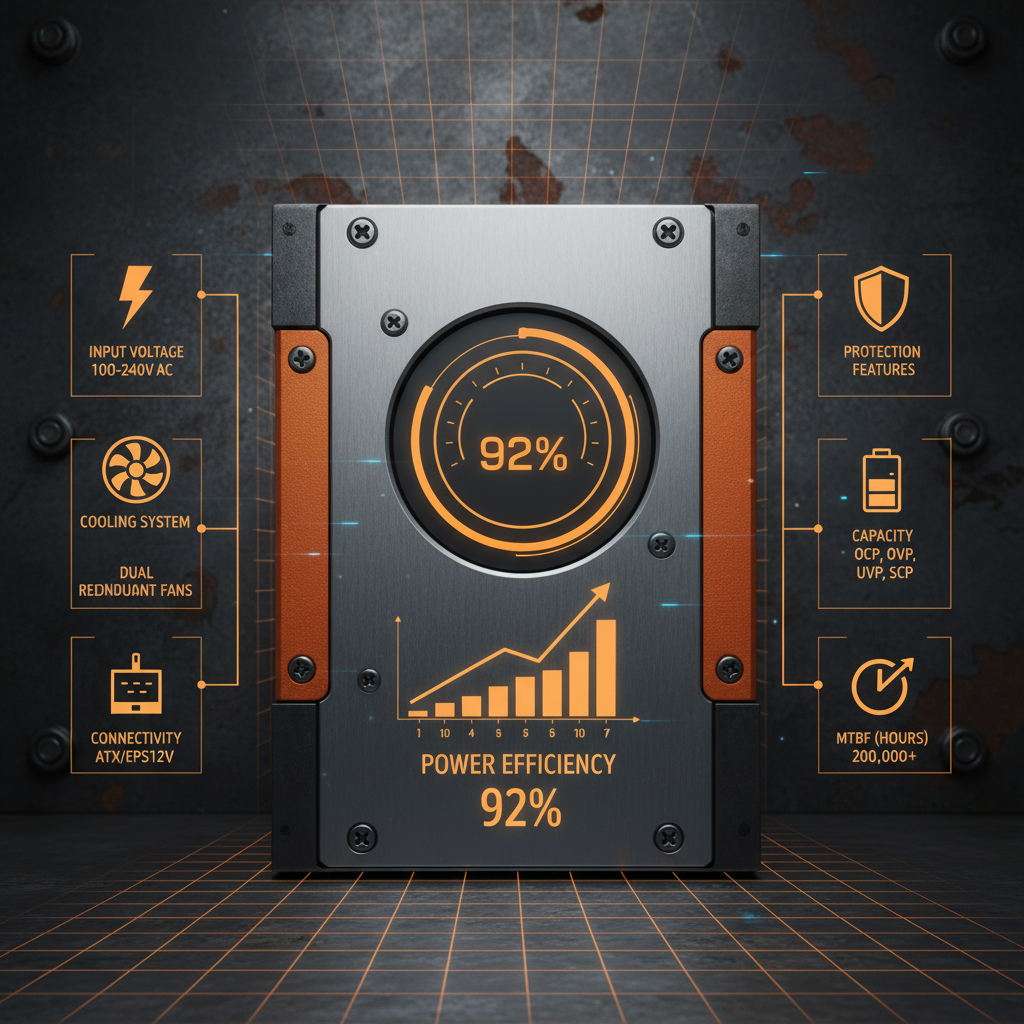
PSU efficiency is measured by the 80 PLUS certification, which indicates how effectively the PSU converts AC power from the wall into DC power for your server components. Higher efficiency ratings mean less wasted energy, lower operating costs, and reduced heat generation. The 80 PLUS certification levels include White, Bronze, Silver, Gold, Platinum, and Titanium, with Titanium being the most efficient. For a home server power supply, an 80 PLUS Gold or Platinum rating is highly recommended for optimal performance and energy savings.
80 PLUS Certification Levels:
• White: 80% Efficiency
• Bronze: 82% - 85% Efficiency
• Silver: 85% - 88% Efficiency
• Gold: 87% - 90% Efficiency
• Platinum: 90% - 94% Efficiency
• Titanium: 94% + Efficiency
Home Server Power Supply Form Factors and Connectors
PSUs come in various form factors, the most common being ATX, SFX, and TFX. ATX is the standard size for most desktop servers and offers the widest range of options. SFX is a smaller form factor suitable for compact server builds, while TFX is often used in smaller cases. Ensure the PSU's form factor is compatible with your server case. Also, verify that the PSU has the necessary connectors for your components, including 24-pin ATX, 4/8-pin EPS, PCIe connectors for graphics cards (if applicable), and SATA connectors for storage drives. ACDC Bess offers PSUs with a wide range of connectors to accommodate diverse server configurations.
Key Features to Look For in a Home Server Power Supply
Beyond wattage and efficiency, consider features like modularity, which allows you to connect only the cables you need, reducing clutter and improving airflow. Japanese capacitors are known for their reliability and longevity. Protection features, such as over-voltage, under-voltage, short-circuit, and over-temperature protection, are crucial for safeguarding your server components. Finally, a long warranty period indicates the manufacturer's confidence in the product's quality. ACDC Bess PSUs are engineered with these features in mind, providing a robust and reliable power solution.
Conclusion: Powering Your Home Server for Years to Come
Investing in a quality home server power supply is a critical investment in the long-term reliability and performance of your server. By carefully considering your power needs, efficiency ratings, form factors, and key features, you can select a PSU that will provide stable and efficient power for years to come. Don't compromise on power – choose a PSU from a trusted brand like ACDC Bess.
Frequently Asked Questions (FAQs)
What wattage power supply do I need for a home server?
The required wattage depends on your server's components. A basic home server with a low-power CPU and a few HDDs might only need 300-400W. However, a more powerful server with a dedicated GPU, multiple drives, and expansion cards could require 600W or more. Calculate the total power draw of all components and add a 20-30% buffer for headroom. Using a PSU wattage calculator online can also be helpful.
What is the difference between a modular and non-modular power supply?
A non-modular PSU has all its cables permanently attached, while a modular PSU allows you to connect only the cables you need. Modular PSUs offer better cable management, improving airflow and making your server build cleaner and easier to work with. While typically more expensive, the benefits of reduced clutter and improved cooling often make them worthwhile.
How important are Japanese capacitors in a power supply?
Japanese capacitors are highly regarded in the PSU industry for their reliability, stability, and long lifespan. They are less prone to failure than lower-quality capacitors, especially under high temperatures and stress. PSUs using Japanese capacitors typically have a longer lifespan and are more resistant to component degradation, making them a worthwhile investment.
What protection features should I look for in a power supply?
Essential protection features include Over-Voltage Protection (OVP), Under-Voltage Protection (UVP), Short-Circuit Protection (SCP), Over-Power Protection (OPP), and Over-Temperature Protection (OTP). These features safeguard your server components from damage due to power fluctuations, surges, or overheating. A PSU with comprehensive protection features will significantly enhance the stability and longevity of your server.
-
Cedar Point EV Charging Solutions for Sustainable Tourism Experience
NewsApr.16,2026
-
Guide to Cedar Point Charging Stations for EV Park Visitors
NewsApr.16,2026
-
Acorn Stairlift Charging Point Guide for Home Mobility Optimization
NewsApr.16,2026
-
Integrating a Wireless Charging Point into Modern Infrastructure
NewsApr.16,2026
-
How to Optimize Your iPhone 14 Charging Point for Efficiency
NewsApr.16,2026
-
Analyzing the Charging Point Share Price Trends and Market Outlook
NewsApr.09,2026